In brief
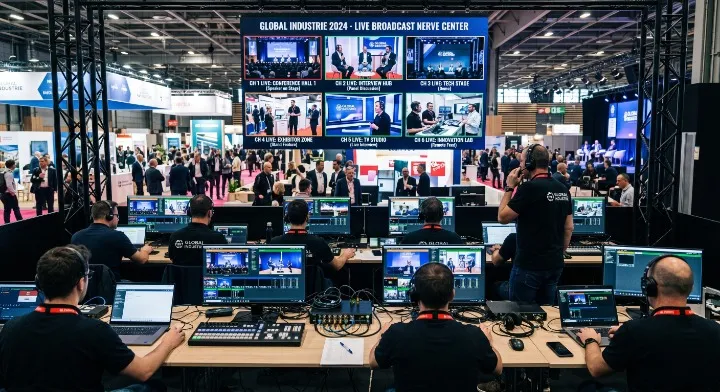
Technical direction of the live broadcast for Global Industrie on behalf of GL Events, across 3 consecutive editions. B2B trade show with 6 live content channels broadcast in parallel for 4 days non-stop.
Producing 6 simultaneous live channels each with its own editorial running order. Holding continuity for 4 days without interruption, with reliable redundancy. Coordinating a team of 8 technicians across multiple stages.
8 vMix galleries architecture: one gallery dedicated to each of the 6 live channels, plus a redundancy gallery ready to take over any channel in case of failure, plus a spare gallery on standby. Every vMix receives all sources and switches according to its programme.
3 consecutive editions delivered. Renewed by GL Events from one edition to the next. No major channel interruption across the 4 non-stop days.
SIMILAR PROJECT
Let's talk about your event
Online estimate, written exchange or direct call, your choice.
Context
Global Industrie is France's largest industrial trade show. Over 2,500 exhibitors, 60,000 professionals, 750 speakers across multiple stages, four days of non-stop activity at Eurexpo Lyon or Paris Porte de Versailles depending on the edition. The trade show is run by GL Events, a major player in international events.
I've been the technical director and broadcast setup coordinator for Global Industrie for three consecutive editions, each with a different format and constraints:
- 2022 edition: 100% online format due to the public-health crisis. Multi-site multiplex setup to gather contributions from exhibitors and speakers from their respective sites and assemble them in a central gallery.
- 2023 edition: back to in-person at Eurexpo Lyon, first deployment of the on-site 6-channel broadcast setup.
- 2024 edition: renewal of the setup at Paris Porte de Versailles, scaled-up coordination across stages and feeds.
Three consecutive editions is the kind of trust relationship you can't fake. GL Events is itself an event-industry professional: their renewal year after year is the best indicator of how robust the setup is.
Constraints
- 6 channels live simultaneously, for 4 days: each channel follows its own running order timed to the second. At any given moment, each channel can switch between a conference in a hall, the show's TV studio, or a pre-recorded video segment. Everything is rigorously planned.
- Physical distance between sources: several conferences filmed in different halls across the show, plus a TV studio set up elsewhere, plus mobile galleries deployed on stands. Bringing all those feeds back to the central gallery across the distance of an exhibition hall covering several thousand square metres demands a dedicated infrastructure.
- Imposed venue network: the Eurexpo / Porte de Versailles network is what it is, you have to work with it. No total freedom to redeploy an infrastructure, you compose with what's there and its limits.
- Contacts not always available: the venue teams have their own emergencies during 4 days of trade show. When a network issue arises, you often have to find the solution yourself without waiting.
- Last-minute scheduling changes: on an event of this scale, running orders evolve continuously. A speaker cancelled, a roundtable shifted, a surprise guest added. The 6 channels have to absorb these changes live to keep the feed continuous.
The setup
The technical architecture is designed like a TV broadcast gallery, with centralised sources and controlled redistribution to each channel.
Multi-channel broadcast architecture
- Input sources: several conferences filmed in show halls, a TV studio with continuous exhibitor interviews, mobile galleries deployed on stands to cover demonstrations in real conditions
- Centralised collection: all SDI feeds brought back to a central distributor, available for redistribution to every channel
- 8 vMix galleries: one dedicated gallery per channel for the 6 live channels (each with its own director-operator following the channel's running order), one redundancy gallery ready to take over any channel in case of failure, and one spare gallery on standby. Every vMix receives all sources and switches according to its programme.
- Central switching gallery: overall supervision, management of pre-recorded video segments, on-screen graphics, quality validation before broadcast
- 6 simultaneous broadcast feeds pushed to GL Events platforms for online viewers
An 8-person team to coordinate in real time
On a broadcast setup at this scale, technique alone isn't enough. Human coordination is at least as critical. I led 8 people across the show for the entire duration: vMix directors, camera operators, network technicians, the leads filming in the remote halls.
My role wasn't to switch the channels myself. It was to make sure the 8 human channels worked together: every director receives an up-to-date running order, every camera operator is briefed on the requests from the hall they cover, incidents are escalated to the central gallery for immediate resolution. It's a technical direction and production role, not an execution one.
That's what makes the difference between a solo operator filming an event and a technical director able to run an industrial broadcast setup. Both roles are useful, but they don't address the same needs and don't bill the same way.
Managing a network you didn't choose
The network of an exhibition centre like Eurexpo or Porte de Versailles isn't designed to carry 6 simultaneous broadcast video feeds for 4 days. You have to negotiate with what's there, sometimes add capacity locally, sometimes reorganise network paths depending on coverage zones. It's work largely done upstream with the venue teams, but it still has to be tuned during the event.
On a setup of this size, preparation runs into several months. Cabling plans, vMix architecture, feed-return tests from the remote halls, load simulation, failover procedures. By the time you arrive on site for the show week, everything must already have been thought through.
How it ran
- Several months ahead: setup preparation with GL Events. Technical architecture, cabling plans, validation of provisional running orders per channel, coordination with venue teams for network points.
- Show week: on-site deployment, installation of the central SDI distributor, connection of the 8 vMix systems, source-to-channel testing, full switching simulations.
- Show days (4 days): continuous filming and broadcasting of the 6 channels, 8 hours a day non-stop. Morning team briefing, live management of schedule changes, incident resolution without interrupting the broadcast.
- After the show: de-rig, gear return, delivery of the recordings and rush archiving for the GL Events teams.
Results
- 6 streams running continuously, 8 hours a day, for 4 days: setup held end to end across all three editions.
- Several tens of thousands of cumulative views on GL Events broadcast platforms.
- Three consecutive editions renewed (2022, 2023, 2024) by GL Events, with the setup scaling up at each edition.
- No major incident causing a broadcast outage on any of the 6 channels.
What I take away
Running the broadcast setup for Global Industrie taught me what it really means to work at industrial scale. When you have 6 channels broadcasting continuously for 32 cumulative hours over 4 days, the smallest details start to weigh: the lifespan of a cable, the temperature of a gallery rack, the fatigue of a director after 6 hours of continuous switching, the morning-briefing coordination making sure every operator knows their up-to-date running order.
This is no longer event filming in the classic sense. This is industrial broadcast. And it's exactly for this kind of mission that the distinction between "solo operator who films" and "technical director who orchestrates" becomes meaningful. Technical mastery is necessary, but the ability to coordinate a team across several days is what makes the difference for setup reliability.