In brief
Technical direction of the Johnson & Johnson product launch, two-way multiplex across 6 cities in France (Paris + 5 regions). Renewed in 2025 after a first edition in 2022.
Connecting 6 cities simultaneously at broadcast quality. Allowing two-way contributions between sites for a dialogue format. 14 cameras to coordinate (4 in Paris, 10 across the regions). Confidentiality and logistics standards of a major pharma group.
Central gallery in Paris coordinating the 5 remote sites. Secure, redundant internet links in every city. One expert technician per remote site to run the local filming. Running order timed in advance and full briefing of every operator.
2022 edition delivered without incident. Renewed in 2025 with the same setup. A reference for the multi-city two-way multiplex format in France.
SIMILAR PROJECT
Let's talk about your event
Online estimate, written exchange or direct call, your choice.
Context
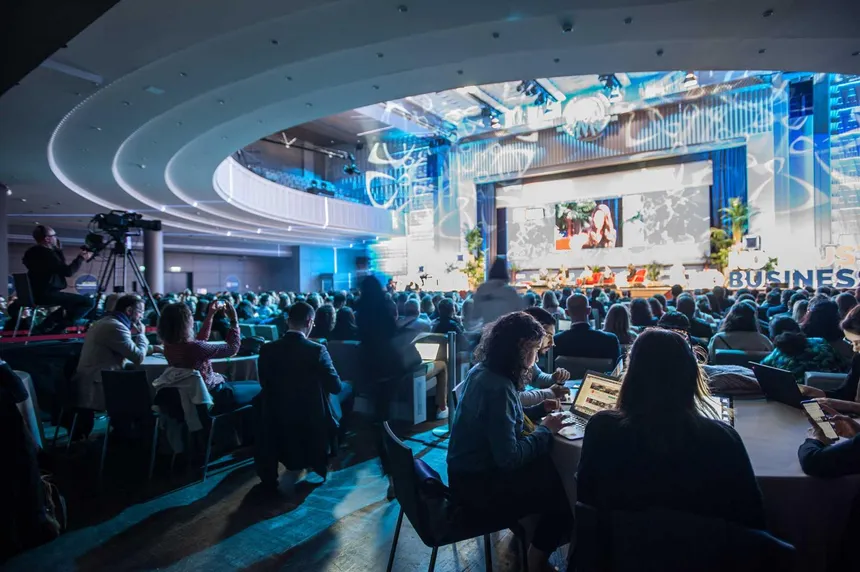
On 15 September 2022, at the Maison de la Mutualité (Auditorium) in Paris, Johnson & Johnson held the launch of one of its products for the French medical community. Format: a central studio in Paris, and five regional sites connected live across France so doctors in every major French city could take part without travelling.
The event was commissioned by K Particulier, a healthcare-specialist agency that entrusted me with the technical direction of the entire multiplex setup. The quality of the setup led J&J and K Particulier to renew the format in 2025, on another launch with the same architecture.
The two-way 6-city multiplex architecture
What sets this setup apart from a classic event multiplex is its two-way nature. The 5 regional sites are not passive viewers receiving a feed. Each city can take the floor live, exchange with the Paris studio, and interact with the other cities. The doctors at every remote site can ask their questions and receive answers live.
In practice, at any moment t, you can switch between 6 video and audio sources. A Paris-based doctor speaks from the studio, a Bordeaux doctor asks a question, a Lyon panel interacts with a Marseille panel, and all of this unfolds live in front of the medical audience, without breaks, without dead time, without perceptible latency.
The 6 connected cities
- Paris (Auditorium de la Mutualité): central studio, 4 cameras including one shoulder camera, 5 technicians, central gallery
- Toulouse: 2 cameras, 1 expert technician on site
- Bordeaux: 2 cameras, 1 expert technician on site
- Lyon: 2 cameras, 1 expert technician on site
- Marseille: 2 cameras, 1 expert technician on site
- Lille: 2 cameras, 1 expert technician on site
Constraints
- Exclusively medical audience: doctors are watching. The expected technical standards match those of a professional broadcast production. Stable image, flawless sound, full readability of the projected scientific content. Zero tolerance for error.
- Total confidentiality: pharmaceutical product launch, event under embargo. No public stream, encrypted internal platform, NDA signed by the entire technical team including me.
- Synchronisation of the 6 sites: in a two-way logic, the latency between Paris and the speaking site has to stay below the natural-interaction threshold. Beyond 1.5 seconds, exchanges become impossible, doctors cut each other off without meaning to.
- Prestigious venue: the Auditorium de la Mutualité is one of the major Paris conference halls (1,800 seats). The technical setup has to live up to the venue, in image quality and discretion alike.
The technical setup
Broadcast architecture
- Paris studio: 3 fixed 4K PTZ cameras for speaker and plenary shots, 1 shoulder camera for movement and dynamic shots. Centralised vMix gallery with pre-validated J&J branding
- Regional sites: 2 cameras per city, mixed locally to produce a single feed sent back to Paris
- Transport: mix of dedicated fibre and SRT depending on the sites. Fibre where available (equipped sites), encrypted SRT when using internet links
- Central Paris gallery: switching between the 6 sources, managing speaking turns, validation of images shown before broadcast
- Encrypted private broadcast: internal platform with token-based doctor authentication, no public stream
An expert technician on each remote site
On a two-way multiplex of this scale, there's no room for approximation. Each regional site was run by an expert technician, briefed in advance, physically present on site, connected to the central gallery via talkback and video return. This human redundancy ensures that if a local issue arises (camera failure, network drop, sound problem), the solution is found within seconds without interrupting the broadcast.
It's a choice that affects the budget but, on this kind of sensitive setup, isn't negotiable. With a setup remotely run from Paris for the 5 regional sites, the smallest local failure would have become a disaster broadcast live to doctors. With an expert technician on site in every city, it's a minor incident invisible on air.
My role: overall technical direction from Paris
I was physically in Paris, in the central gallery at the Auditorium de la Mutualité, as technical director of the entire setup. My job wasn't to operate a camera or switch sources, it was to coordinate the full team: the 5 Paris technicians and the 5 regional technicians. Morning briefing, technical follow-up during the live, validation of switches between sites, real-time incident management.
On this kind of setup, technical direction is prepared months in advance. Site surveys at the 6 venues, validation of fibre/SRT connectivity, selection of the regional technicians, video briefings, failure simulations. On the day, everything must already have been thought through. A technical director's role is no longer to discover problems; it's to have anticipated the solutions.
How it ran
- 4 to 5 months ahead: coordination with K Particulier and J&J, validation of the technical setup, NDA signing, pharma compliance briefing, selection of the 5 regional technicians.
- Weeks before: regional site surveys, fibre and SRT connectivity tests, validation of the per-site technical architecture, detailed briefing of every expert technician.
- Day-before: simultaneous installation across the 6 sites, real-conditions tests of every regional contribution to Paris, failure simulations, final validation.
- D-day (15 September 2022): morning and afternoon dedicated to the final technical setup. 2-hour live in the evening, 6 cities connected simultaneously, ongoing two-way interactions between Paris and the regional sites.
- 2025 edition: renewal of the setup on a new launch, with the same 6-city multiplex architecture.
Results
- 6 cities connected two-way over the 2-hour live, with no major technical incident interrupting the broadcast or affecting any site's speaking turn.
- Engaged medical audience across the 6 cities, able to interact with the Paris studio and between regional sites as if they were in the same room.
- Pharma compliance respected throughout the event, validated by the regulatory affairs teams.
- Renewed in 2025 by K Particulier and J&J with the same 6-city multiplex architecture, for a new product launch. The best proof of quality for a B2B technical setup.
What I take away
Pharma and healthcare environments come with compliance constraints often underestimated in standard quotes. Branding can't be modified live; some visuals must appear exactly as validated in advance. It's not a technical constraint, it's a process constraint, and it forces a level of preparation well above a standard corporate event.
But the real specificity of this setup isn't pharma: it's the two-way 6-city multiplex. Having a site take the floor is technically achievable. Having 6 sites that can all take the floor and interact with each other for 2 hours without breaking is another level of demand. It requires a redundant architecture, a 10-person team with 5 dispersed across the country, and very early preparation that anticipates failures rather than reacting to them.
Renewing this kind of setup in 2025 after a successful first edition in 2022 confirms an idea that runs through all my case studies: the quality of a technical direction is measured by how long clients keep trusting you with it. And the more sensitive the setup, the more slowly that trust is earned, but the longer it lasts.