In brief
Long-standing event provider for Morning Coworking since 2017, white-label for clients renting out the spaces. Around 40 events per year, over 300 filming sessions cumulated over 8 years. About ten Paris buildings covered (Laffitte, Cléry, Concorde…).
Holding a constant quality standard across dozens of events per year. Adapting to the diversity of buildings in the network, from contemporary open-space to listed heritage venues. Staying invisible behind the Morning brand vis-à-vis the end client.
A standard setup honed over 8 years: multi-camera filming, sound, live streaming when needed. Detailed knowledge of every Morning building, which means arriving on site survey with a setup already calibrated. Strict white-label: zero Nomacast visibility to the end client.
8 years of trust. Renewed every season by every successive Morning event project lead. Over 300 filming sessions delivered without major incident.
SIMILAR PROJECT
Let's talk about your event
Online estimate, written exchange or direct call, your choice.
Context
Morning, formerly Morning Coworking, is one of France's leading premium workspace operators. More than 60 spaces in Paris and Île-de-France, ranging from 1,000 to 10,000 m². A subsidiary of the Nexity group since 2019, B Corp certified in 2022, the company has made corporate events one of its flagship offerings: every Morning building has dedicated rooms that client companies can rent for their professional events.
I've been the lead event provider for Morning since 2017, eight years of continuous collaboration. Over time, I've worked with every Morning event project lead, across about ten different buildings of the network, on an average of around 40 events per year. Cumulated over the duration, that's more than 300 filming sessions in Morning spaces.
My role: white-label technical provider
In this collaboration, I don't appear under the Nomacast name to the end client. Morning commissions me, Morning pays me, Morning re-bills the service to the renting company. The end client doesn't necessarily know there's an external provider behind the filming: to them, it's an event service integrated into the Morning offering.
This white-label model is exactly what I openly offer to partner agencies who want to enrich their event offering without building an in-house technical team. Morning is the most concrete proof that this model works over time: after eight years, when every project lead in a company calls you regularly, that's a sign the model holds.
The buildings I work in regularly
Across the ten or so Morning buildings where I've filmed events over the years, three come up especially often in my schedule:
Three recurring addresses
- Morning Laffitte (Paris 9th): glass building, 1,000 workstations, modular event spaces in the heart of the business district.
- Morning Cléry (Paris 2nd): expanded Sentier district, cosy event rooms suited to client conferences of 50 to 100 people.
- Morning Concorde (Paris 8th): the most prestigious in the network, located inside the Hôtel de la Marine on Place de la Concorde. 6,000 m² across 3 floors, 252 years of heritage history, sweeping view over Place de la Concorde.
Working at Concorde means operating technically inside a working historic monument. Heritage constraints are tight, discretion requirements absolute, but the venue remains a major commercial asset for Morning's client companies who hold their strategic events there.
Typical format: client conferences
The events I film are almost exclusively client conferences run by companies renting Morning spaces. Average audience of 50 to 100 people, keynote or panel format, 1 to 3 hours, with or without live streaming depending on the client's request.
Standard technical setup
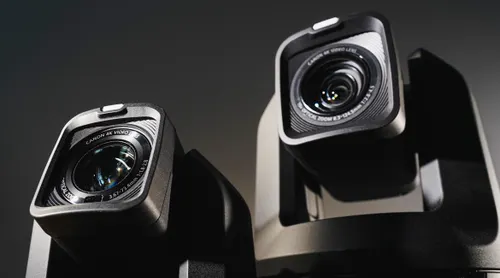
- 3 Canon PTZ cameras over NDI: wide shot, medium speaker shot, close-up audience or details
- Stage lighting kit sized to the room for clean exposure of speakers
- Centralised vMix gallery for switching and branding
- Sound take from the on-site gallery via direct XLR, in collaboration with the Morning building's stage manager
- Live streaming in 50% of cases depending on the end client's needs, on the requested platforms (YouTube, LinkedIn, internal platform)
- Post-event delivery of the usable file
Working with the Morning building stage managers
Every Morning building has a stage manager on site who handles sound, lighting and the room's equipment. Rather than duplicating those skills by bringing my own sound setup, I take the sound mix directly from their gallery via XLR. This approach has three advantages: it relies on the professional sound equipment already installed in every room, it avoids overloading my logistics and the client's cost, and it values the work of the Morning technical teams who know their room better than anyone.
That kind of smooth collaboration with the on-site stage managers is what makes us work in trust after eight years. Every stage manager knows I'll respect their gallery, their sound configuration, their preferences. And I know I can rely on their detailed knowledge of the room to anticipate friction points.
A modular setup, scaled to the need
My standard setup at Morning is a solo operator: 3 cameras, video gallery, lighting, sound take from the gallery. That's plenty for the majority of 50- to 100-person client conferences, and it's what allows me to hold a tight budget while guaranteeing professional-grade quality.
When the sound need exceeds what the local gallery can produce (event with extra wireless mics, multi-speaker interview filming, post-production audio quality requirement), I activate an additional module via my regular sound partner Dinosaures: a dedicated sound technician arrives with their own equipment, integrated into my overall setup. I remain accountable to Morning for everything; I just slot the sound module into my schedule.
Same modular principle I offer to every partner agency: solo by default, partner team on demand when scope requires it. This flexibility lets me precisely fit the setup to the actual need, without billing a full team when it isn't necessary.
Why this collaboration has lasted eight years
When a client like Morning works with a provider for eight consecutive years, and every internal event project lead ends up calling them regularly, it isn't by chance. Three things, in my view, explain that continuity:
- Technical reliability: across nearly 40 events per year, over 8 years, more than 300 filming sessions, the setup has consistently proven reliable. That regularity in the result is what reassures project leads when they hand me a client.
- Operational responsiveness: Morning's event project leads often have tight requests. I'm reachable, I reply quickly, I adapt to the end client's schedule, I find the solution even when the brief shifts 48 hours from the event.
- Relationships with stage managers and project leads: after eight years, the faces are familiar, the technical codes are shared, the habits are honed. That accumulated trust saves everyone time, and it's what turns a one-off mission into a long-standing partnership.
What I take away
Working white-label for Morning for eight years is the most concrete illustration of what I can bring to a partner agency or to a company offering an event service without an in-house technical team. The model is exactly the same: I run the filming, you keep the client relationship, you bill your price, I bill mine.
What sets this case study apart from the others in my portfolio is precisely the invisibility of the provider. On the Louvre, on EBG Berlin, on the Comédie-Française, on Global Industrie, the client institutions know who I am and own it. On Morning, the end client doesn't know me and doesn't need to. Morning is the brand on display, Morning's event reputation is what's served. And that's exactly what agencies or operators who call me are looking for.
Ultimately, the quality metric for white-label work is measured by two things: how long the partner keeps you, and how many different people inside that organisation end up working with you. On both, Morning is today my best reference.